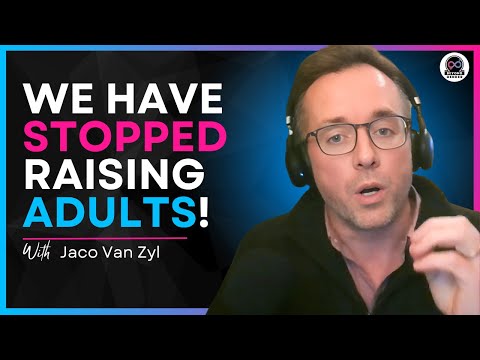
Jaco van Zyl
South African psychotherapist and writer
Jaco van Zyl is a South African psychotherapist who argues that a generation raised on gratification over duty — and on subjective truth over shared reality — is paying a steep psychological price. His work carries particular urgency in Ireland, where adolescent mental health referrals have surged and a culture of therapeutic over-validation has quietly reshaped how schools, clinics and families respond to distress.
Jaco van Zyl is a South African psychotherapist whose clinical work centres on adolescent development, identity, and the cultural forces shaping psychological health in the modern West. Trained in a tradition that takes both inner life and external reality seriously, he has become one of the more distinctive voices challenging what he sees as a therapeutic culture that flatters rather than fortifies young people.
He joined Stella O'Malley and her co-hosts for episode thirteen, What Happens When a Generation Grows Up Without Reality, one of the most searching conversations the Beyond Gender podcast has produced. Van Zyl's central argument is that Western societies have made a damaging trade: they replaced the expectation of duty and endurance with the promise of endless self-affirmation, and in doing so have left adolescents ill-equipped to meet the friction of actual life. His analysis of gentle parenting — not as a straw man but as a sincere cultural project that has, in his view, overshot the mark — and his account of how subjective truth has displaced shared reality will resonate with anyone working in Irish secondary schools or CAMHS waiting rooms.
For Irish clinicians, teachers and parents, Van Zyl offers something rarer than a diagnosis: a framework for why things went wrong without surrendering compassion for the young people caught inside it. His perspective sits naturally alongside Stella O'Malley's Irish psychotherapeutic practice, which has long tracked the same rise in adolescent distress and the same institutional reluctance to name its causes plainly.
His thinking is shaped by deep familiarity with developmental psychology and with the lived reality of young people who present in therapy not because they lack care, but because the care they have received has never asked them to grow.